What Is an IBAN Number? A US Guide to IBANs and SWIFT
SectoJoy
Ox Calculator editorial content focused on clear, practical explanations for calculator use cases.
Quick Summary
An IBAN is a 34-character international account code used in ~90 countries — but US banks don’t issue them. Here’s how IBANs work (structure, MOD-97 check digits) and what US senders use instead: routing number + SWIFT/BIC.
- What Is an IBAN Number? Definition, Scope, and Limits
- The 30-Second Definition
- What an IBAN Is Not
Editorial Review
This article was written or reviewed by SectoJoy and checked against Ox Calculator editorial standards for clarity, accuracy, and practical usefulness.
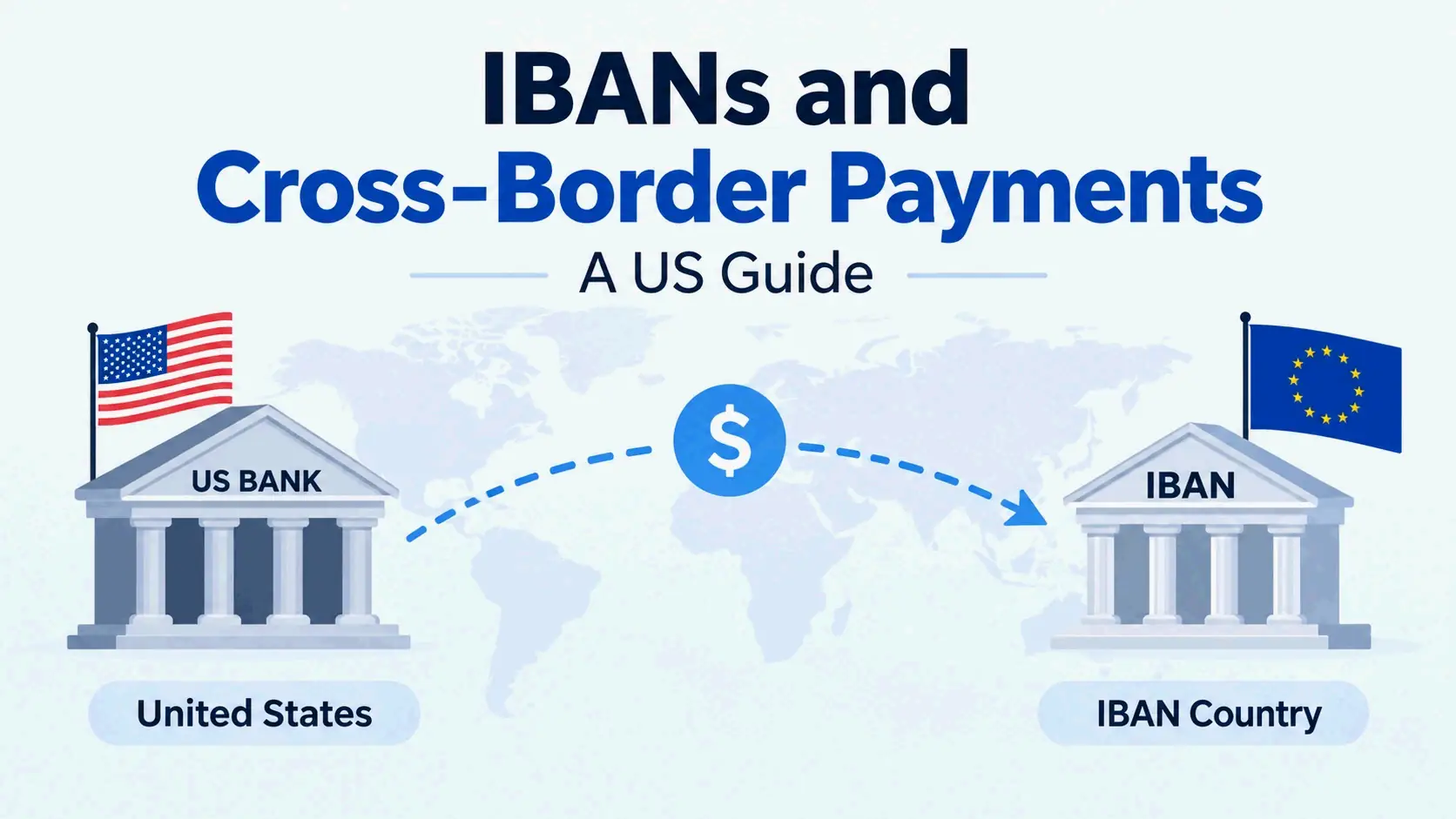
An IBAN (International Bank Account Number) is a standardized code of up to 34 characters that identifies a specific bank account for cross-border payments. It combines a two-letter country code, two check digits, and a country-specific BBAN. US banks do not issue IBANs, so US senders and recipients use a routing number plus the bank’s SWIFT/BIC code instead.
What Is an IBAN Number? Definition, Scope, and Limits
An IBAN is an internationally agreed way to identify bank accounts across national borders. The goal is to reduce transcription errors and let banks in different countries process cross-border transactions using one consistent format, instead of a patchwork of national account-numbering schemes. An IBAN points to one customer’s account at a financial institution; it is not a generic bank address or a payment network.
The standard behind it is ISO 13616. According to Wikipedia’s overview of the International Bank Account Number, the format was originally adopted by the European Committee for Banking Standards (ECBS) and has been published as the international standard ISO 13616 since 1997. The current version is ISO 13616:2020, which names SWIFT (the Society for Worldwide Interbank Financial Telecommunication) as the formal registrar.
The 30-Second Definition
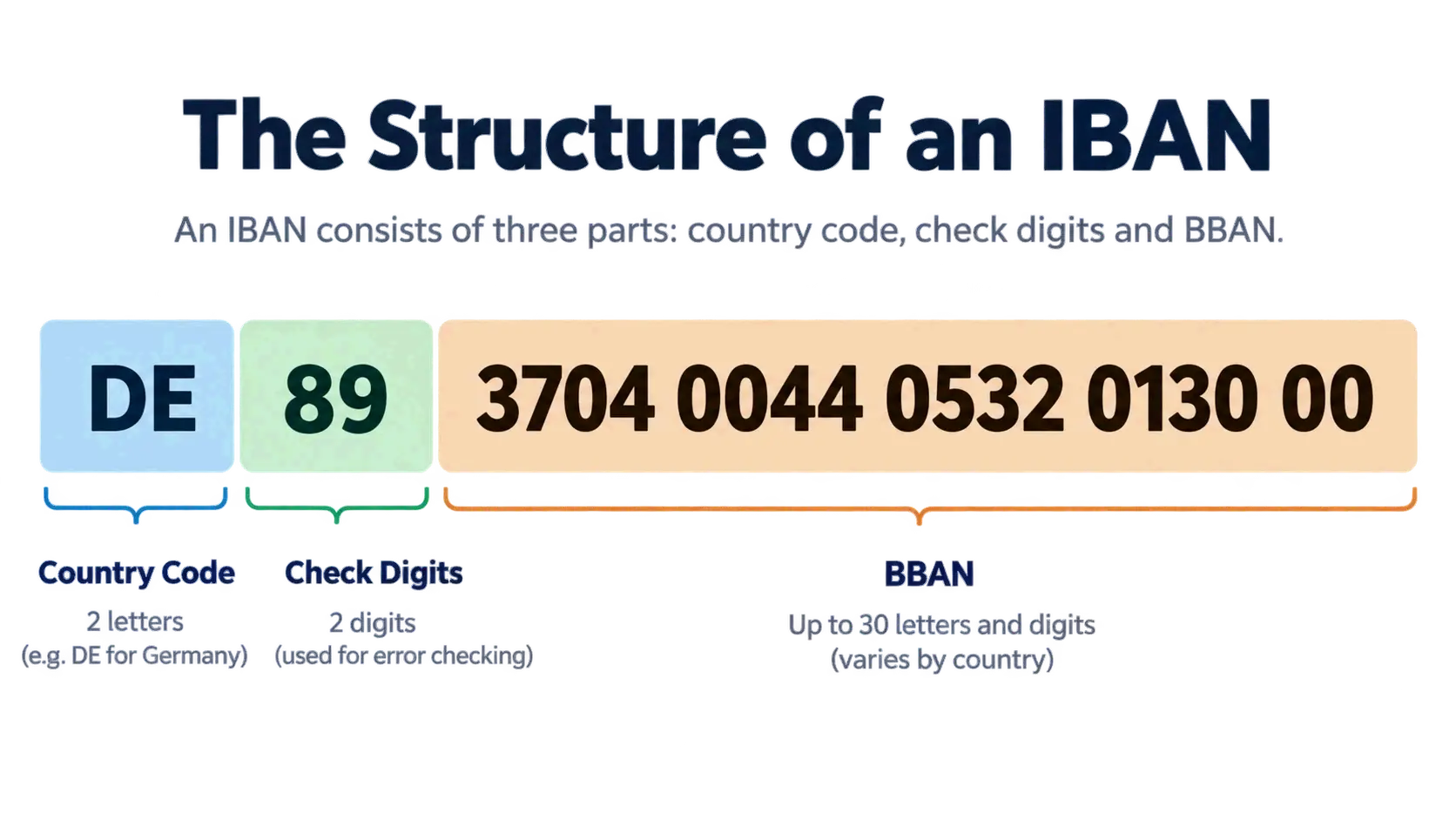
An IBAN is a string of up to 34 alphanumeric characters made of three parts: a two-letter country code, two check digits, and a country-specific Basic Bank Account Number (BBAN) that holds the domestic bank code, branch identifier, and account number. Banks validate the check digits before releasing a payment, which catches most single-character typos at the point of data entry. In practice, an IBAN answers one question: which exact account, at which bank, in which country.
What an IBAN Is Not
An IBAN is not a bank identifier. A bank identifier — the SWIFT/BIC code — points to an institution or branch, while an IBAN points to a specific account inside that institution. International wires commonly require both.
An IBAN is also not a payment network. SWIFT, SEPA, ACH, Fedwire, and card networks move or message money; an IBAN is only an addressing standard that those systems read.
Finally, an IBAN is not a US routing number. A routing number is a nine-digit domestic code, and it is not accepted as an IBAN substitute in any IBAN country. As Ramp’s guide to IBAN numbers puts it, if a form asks you for a US IBAN, there simply isn’t one to provide.
The practical boundary for US readers is simple: US banks do not issue IBANs, which is why the rest of this guide focuses on what US senders and recipients actually put on a payment form.
Do US Banks Issue IBANs? What to Use Instead
No. US banks do not issue IBANs, and US accounts are not assigned one when opened. The United States relies on ABA routing transit numbers for domestic account identification, and on SWIFT codes for international routing. Any adoption of the IBAN standard by US banks would likely be initiated by ANSI ASC X9, the US financial services standards development organization — a working group (X9B20) was established as an X9 subcommittee to generate an IBAN construction for US bank accounts, but nothing has replaced routing numbers in practice.
The US substitute is a three-part package: a nine-digit ABA routing number, the account number, and the bank’s SWIFT/BIC code whenever the payment crosses a border.
Domestic rails explain why the US never needed IBANs. ACH, Fedwire, FedNow, and RTP all operate inside a single national numbering system, so nine-digit routing numbers plus account numbers are sufficient for the vast majority of US payments. SEPA Instant plays an equivalent same-country role in the euro area, but it sits on top of IBAN-based accounts.
What to Put on an International Payment Form as a US Sender
When a US bank’s wire form asks for beneficiary details, use the recipient’s local fields, not US ones. The typical field-by-field entries look like this:
- Beneficiary IBAN or account number: enter the full IBAN for the recipient’s country, exactly as provided, with no spaces and no edits to the check digits.
- Beneficiary bank SWIFT/BIC: the 8- or 11-character code identifying the recipient’s bank.
- Beneficiary name and address: exactly as the account is registered.
- Your routing number and account number: these identify your own US account as the source of funds, not the recipient.
- Intermediary bank details: requested when your bank has no direct relationship with the recipient’s bank.
If a form asks for a “US IBAN” on your side, there is nothing to enter; your routing number and account number serve that role.
What to Give a Foreign Payer as a US Recipient
A foreign payer sending money into a US account needs four details: your bank’s nine-digit ABA routing number, your account number, your bank’s SWIFT/BIC code, and the account holder name as registered.
Multi-currency providers such as Wise and Revolut can assign IBANs to eligible accounts precisely so international payers have a single validated identifier to use. If you hold an account with one of those providers and it has been issued an IBAN, share that IBAN instead of domestic details. If you bank with a traditional US institution, share the routing number, account number, and SWIFT/BIC combination.
One timing detail matters on the receiving end: funds arriving in a foreign currency are converted at the prevailing exchange rate before they reach your account, so the number on the invoice is not necessarily the number that lands.
How an IBAN Is Structured: Country Code, Check Digits, and BBAN
Every IBAN follows the same three-part sequence, and every part has a fixed job.
The country code occupies the first two characters and uses ISO 3166-1 alpha-2 — DE for Germany, FR for France, GB for the United Kingdom. The country code determines which BBAN format applies, so it is the first thing a validating system checks.
The check digits occupy positions three and four. They are calculated from the rest of the string and validated with the MOD-97 checksum described in ISO 7064, letting a bank confirm the number contains no simple transcription error before submitting a transaction.
The BBAN fills every remaining character, up to a maximum of 30 alphanumeric characters. It carries the domestic bank code, branch identifier, and account number in whatever national format the country uses. The national central bank or designated payment authority decides that format, which is why BBAN structures are not consistent between countries.
Real IBAN Examples by Country
The following examples come from Ramp’s IBAN guide and are illustrative formats rather than live accounts:
| Country | Country Code | Total Length | Sample Format |
|---|---|---|---|
| Norway | NO | 15 | NO93 8601 1117 947 |
| Belgium | BE | 16 | BE68 5390 0754 7034 |
| Netherlands | NL | 18 | NL91 ABNA 0417 1643 00 |
| Germany | DE | 22 | DE89 3704 0044 0532 0130 00 |
| United Kingdom | GB | 22 | GB29 NWBK 6016 1331 9268 19 |
| France | FR | 27 | FR14 2004 1010 0505 0001 3M02 606 |
| Malta | MT | 31 | MT84 MALT 0110 0012 3456 MTLC AST0 01S |
Reading the German example: DE is the country, 89 is the checksum, 37040044 is the bank identifier, and 0532013000 is the individual account number.
Why IBAN Length Varies by Country
Total IBAN length is fixed nationally, which is why it ranges from 15 characters in Norway to the 34-character ceiling. Norway uses 15, Belgium 16, the Netherlands 18, Germany and the UK 22, Spain 24, France and Italy 27, and Malta 31.
Because each country’s BBAN encodes different elements — some include branch codes, some include national check digits, some include account-type indicators — the length cannot be standardized across borders. The IBAN registry is the official source for each country’s length and format, and validating systems check the total length against the country code before running the checksum.
How IBAN Check Digits Work — and What They Don’t Verify
The IBAN check digits use a MOD-97 operation, formally described in ISO 7064, to confirm that a string contains no simple errors. The validation is designed to catch single-character substitutions, nearly all single transpositions, and shifts of the whole string to the left or right.
This matters because it moves error detection to the moment of data entry. A bank’s system can reject a mistyped IBAN immediately rather than discovering the problem days later when the payment bounces back through intermediary banks. That design goal — validating as much as possible at the point of entry — is the core reason IBANs reduced cross-border failure rates compared with the pre-1997 arrangement.
A Worked MOD-97 Example
The validation algorithm has four steps: confirm the total length matches the country, move the first four characters to the end, replace each letter with two digits (A = 10 through Z = 35), then divide the resulting integer by 97. If the remainder is 1, the check digit test passes.
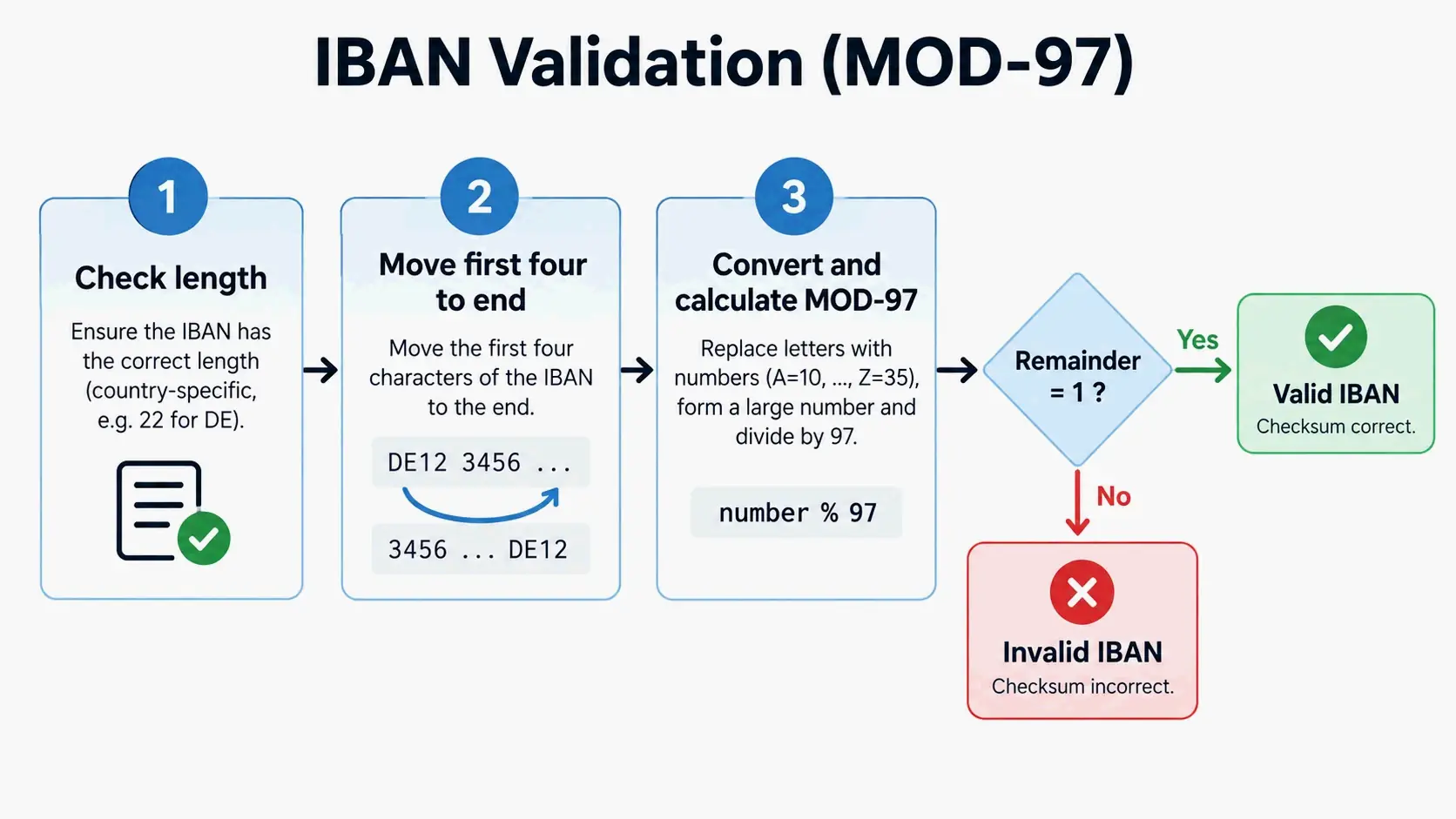
Using the fictitious United Kingdom example published on Wikipedia, IBAN GB82 WEST 1234 5698 7654 32:
- Rearrange: move GB82 to the end → WEST12345698765432GB82
- Convert letters to digits: W=32, E=14, S=28, T=29, then G=16, B=11 → 3214282912345698765432161182
- Compute the remainder: 3214282912345698765432161182 mod 97 = 1
Because the remainder is 1, the string passes the check digit test.
What the Checksum Does Not Check
This is the limitation that costs people money. A checksum-valid IBAN confirms the string is correctly formatted; it says nothing about who owns the account. A wrong IBAN that happens to be mathematically valid will send funds to the wrong recipient.
As Bertrand Théaud, Founder of Statrys, notes: “A correctly formatted IBAN is not proof the payment will land in the right account. For transfers outside the SEPA zone, the check digits catch typos, not wrong account numbers, so validate the account holder’s name yourself, not just the string of characters.”
Inside SEPA, banks are now required to flag a clear name mismatch before sending, though a close-enough match can still pass. Outside SEPA, banks generally do not verify that the recipient’s name matches the account holder before crediting funds, so recovery is slow and not guaranteed. The practical rule is to verify the account holder’s identity independently — by confirming the beneficiary name through a channel you trust — in addition to checking the IBAN string.
IBAN vs SWIFT/BIC vs Routing Number: Which Code Does What?
Each code answers a different question, and mixing them up is one of the most common causes of delayed international payments.
| Criteria | IBAN | SWIFT/BIC | Routing Number |
|---|---|---|---|
| Purpose | Identifies an individual account | Identifies a bank or branch | Identifies a US financial institution |
| Length | Up to 34 characters | 8–11 characters | 9 digits |
| Geographic use | Primarily Europe, Middle East, Caribbean | Worldwide | United States, domestic only |
| Format | Country code + check digits + BBAN | Bank code + country code + location code + optional branch code | Numeric |
An IBAN identifies the account. A SWIFT/BIC code identifies the institution. A routing number identifies a US bank inside the domestic network and never travels beyond it. An IBAN and a SWIFT/BIC code are frequently used together on international wires: the SWIFT code routes the payment to the right bank, and the IBAN directs it to the right account inside that bank.
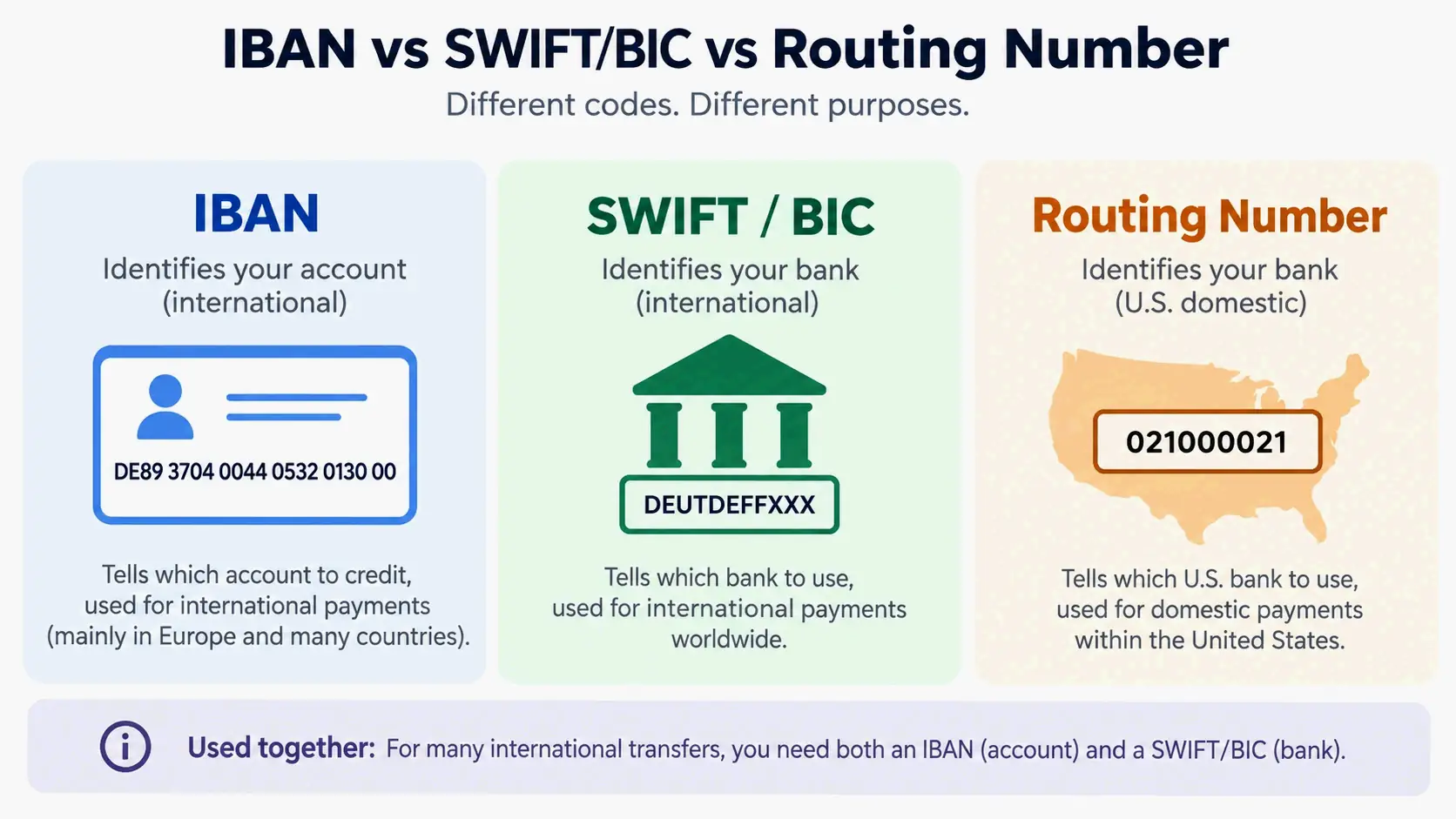
The scale of the SWIFT network explains why SWIFT/BIC codes remain essential even when an IBAN is present. Ramp notes that SWIFT is used by more than 11,000 financial institutions worldwide, and that the network extends beyond traditional banks to brokerage firms, payment processors, and other participants.
When You Need Both an IBAN and a SWIFT Code
You need both when the destination account sits in an IBAN country. A transfer from France to Germany requires the recipient’s IBAN and the recipient bank’s SWIFT/BIC. Within SEPA, an IBAN alone is often sufficient to identify an account, and banks are no longer permitted to require customers to supply the beneficiary bank’s BIC for SEPA payments — but many payment forms still ask for both by default, and non-SEPA transfers generally do require both.
When the destination account sits in a non-IBAN country, such as the US, you provide the SWIFT/BIC code plus the local account and routing details instead of an IBAN.
Why the US Uses Routing Numbers Instead of IBANs
The US financial system was built on domestic rails — ACH, Fedwire, FedNow, and RTP — that all identify institutions with nine-digit ABA routing numbers. Adding IBANs would mean adopting a second, parallel account-identification standard for accounts that already work inside a functioning national system.
That arrangement creates friction in one direction only. US banks recognize the IBAN format and process incoming IBAN payments without issue, but they do not issue IBANs to their own customers. A US routing number, in turn, is not accepted as an IBAN substitute in Europe or anywhere else that uses the standard.
Where IBANs Are Used — and Where They Aren’t
IBAN adoption is usually described in two ways: how many countries use it, and which registry defines the format. Both numbers drift over time, which is why dated figures matter.
According to Wikipedia, 89 countries were using the IBAN numbering system by December 2024. Per the IBAN Register maintained with data licensed from S.W.I.F.T. SCRL and updated 8 May 2026, around 90 countries and territories now use the IBAN format, spanning most of Europe, parts of the Middle East and North Africa, and a growing number of Sub-Saharan African and Central Asian states. Country counts move because new jurisdictions join the standard and register their BBAN formats over time.
Adoption is heaviest in Europe, where the IBAN began inside the European Union. It is also established across the Middle East and the Caribbean, and present in parts of Africa.
SEPA and the Eurozone
SEPA — the Single Euro Payments Area — is the payment network and rulebook that made the IBAN the default account identifier for euro-denominated transfers. SEPA is not a code; it is a scheme in which the IBAN identifies the account and the payment is processed under SEPA rules and timelines.
The transition was staged. The IBAN scheme fully replaced domestic numbering schemes from 31 December 2012, national systems for credit transfer and direct debit were abolished on 1 February 2014, and the requirement extended to all cross-border SEPA transactions on 1 February 2016. After those dates, the IBAN alone is sufficient to identify an account for home and foreign transactions in SEPA countries.
Canada, Australia, and Other Non-IBAN Countries
Canada and Australia do not use IBANs. Canadian financial institutions use routing numbers issued by Payments Canada for domestic transfers and SWIFT for international transfers, with no formal regulatory requirement to adopt IBAN. Australia uses Bank State Branch (BSB) codes for domestic transfers and SWIFT for international transfers — a BSB plus an account number combined is not an IBAN, even if a provider’s form labels it that way. New Zealand follows the same pattern. Most Asian countries, including Hong Kong and Singapore, rely on SWIFT/BIC codes and local account numbers rather than IBANs.
Ukraine illustrates how a country can move onto the standard later. Ukrainian banks had used IBAN-format aliases on an ad hoc basis as a precursor to formal SWIFT registration, and that practice ended on 1 November 2019 when all Ukrainian banks fully switched to the IBAN standard.
One compliance issue worth knowing about inside the euro area is IBAN discrimination: refusing or charging extra for a valid IBAN issued in another SEPA country. It is a rulebook violation rather than a technical limitation.
How to Find Your IBAN (If You Have One)
If you bank in an IBAN country, you do not apply for an IBAN separately — your bank assigns one automatically when you open the account, and it appears in a handful of predictable places.
Five Places to Look
- Online banking: log in and open your account details or account summary page; most banks display the full IBAN alongside your account number and sort code.
- Paper or electronic statements: the IBAN typically appears near your account number and branch information.
- Mobile banking app: check sections labeled account details, international details, or payment details.
- Debit or credit card: some banks, particularly in Europe, print the IBAN on the card itself.
- Bank customer service: call or visit a branch; after verifying your identity, staff can provide the IBAN directly.
US account holders will not find an IBAN in any of these places, because US banks do not issue them. If a form asks for your US IBAN, use your routing number, account number, and the bank’s SWIFT/BIC code instead.
Using an IBAN Calculator Safely
An IBAN calculator can reconstruct a full IBAN from your country code, bank code, and account number if your bank’s document doesn’t display the complete string. Treat third-party calculators cautiously: they are not your bank’s verified site, and entering sensitive account credentials into an unverified tool creates security risk. Prefer your bank’s own website or app, and never supply online banking login details to a calculator.
What Happens If an IBAN Is Wrong or Missing
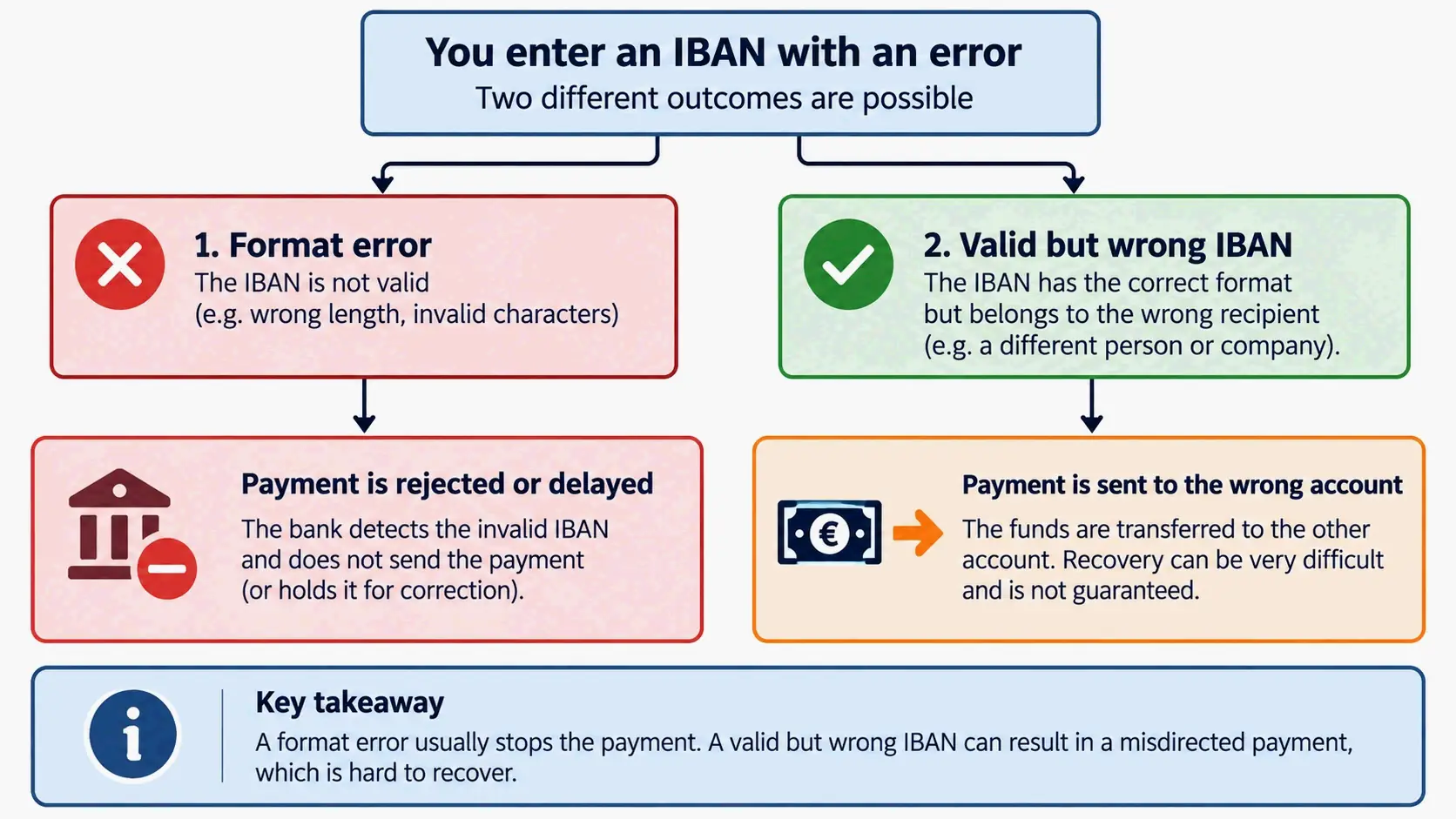
The consequences depend on which kind of error you made. There are two distinct failure modes, and they are not equally serious.
If the IBAN is incorrectly formatted — wrong length, wrong country code, or check digits that fail MOD-97 — the payment is rejected outright or stopped for manual correction. The system catches the error, but the money is still delayed.
If the IBAN is correctly formatted but belongs to someone else, the checksum passes and the funds move. Outside SEPA, banks generally do not verify that the recipient’s name matches the account holder before crediting, so the payment reaches the wrong account and recovery depends on the cooperation of institutions that have no obligation to reverse it quickly.
What a Mistake Costs
Per Statrys, sending a payment with the wrong format, or omitting the IBAN where it is required, routinely adds 3-5 business days and USD 15-40 in correction fees. That figure covers the administrative cost of retrieval and resubmission — it does not include what the payment’s delay costs your business relationship.
International transfer costs also stack up independently of errors. Ramp walks through an illustrative USD 10,000 wire from the US to a German supplier: a USD 35 outgoing wire fee, a USD 20 intermediary bank fee, and an exchange rate 2% less favorable than the reference rate would add roughly USD 255 to the payment cost. The FX spread is typically the largest and least visible line item, which is why comparing the quoted exchange rate matters more than comparing flat wire fees.
| Cost Component | What Drives It |
|---|---|
| Outgoing wire fee | Bank, account type, and transfer method |
| Incoming wire fee | Receiving bank and account type |
| Intermediary bank fee | Payment route and fee instructions |
| FX spread | Provider and currency pair |
| Return or correction fee | Applied when details are wrong or missing |
How to Recover a Misdirected Payment
Contact your bank immediately. Speed is the single largest factor in whether funds can be recalled, because recovery depends on reaching the receiving bank before the money is withdrawn or moved onward.
Ask your bank to issue a recall or return request to the beneficiary bank and to confirm in writing what was sent, when, and to which IBAN. Expect the process to be slow and not guaranteed outside SEPA. As Bertrand Théaud cautions, validate the account holder’s name yourself rather than relying on the string alone — that check is the only reliable protection, because by the time a misdirected payment is discovered, the funds have already landed.
ISO 13616 and the IBAN Registry: Who Governs IBANs
The IBAN standard is not maintained by any single bank or country. It is governed through ISO, with SWIFT acting as the registration authority that administers the country formats.
From ECBS to ISO 13616
The format was originally adopted by the European Committee for Banking Standards (ECBS), which produced a “slimmed down” version of the standard that permitted only upper-case letters and required a fixed IBAN length for each country. ISO published ISO 13616:1997, which was subsequently withdrawn and replaced by ISO 13616:2003. The standard was revised again in 2007 when it was split into two parts: ISO 13616-1, which specifies the IBAN elements, and ISO 13616-2, which describes the registration authority and the procedures for registering compliant country formats. The current version is ISO 13616:2020, which names SWIFT as the formal registrar.
A useful historical marker of how involved country-level migration became: in Germany, the Deutsche Bundesbank and the German Banking Industry Committee required all holders of German bank codes to publish the specifics of their IBAN generation format, including legacy bank code handling, so third parties could generate IBANs independently. The first such catalogue was published in June 2013 as a variant of the old bank code file.
How the Registry Keeps Country Formats Consistent
The IBAN registry is the official catalogue of countries that follow the standard. It records each country’s IBAN structure, character types, and length requirements, along with an update history and definitions of the terms used in IBAN transactions — and it is the reference banks and payment processors check when validating IBANs or updating their systems. Because BBAN formats are set nationally, the registry is what keeps those national decisions legible to every other participating country.
Ukraine’s full switchover to IBAN on 1 November 2019 is a more recent example of how countries move from informal IBAN-format aliases to formal participation in the standard.
Conclusion
An IBAN is an international bank account identifier used in around 90 countries and territories, but the United States does not issue them. US senders and recipients work with routing numbers, account numbers, and SWIFT/BIC codes instead — and any form asking for a US IBAN has no answer to give.
Before sending an international payment, confirm the recipient’s name independently rather than trusting a valid-looking string, verify the IBAN format against the country’s registry or a trusted calculator, and keep the SWIFT/BIC code on file for the recipient’s bank. If you suspect an IBAN error, contact your bank immediately, because recovery gets harder with every hour the funds remain in the wrong account.
FAQ
Does the United States have IBAN numbers?
No. US banks do not issue IBANs, and US accounts are not assigned one. Domestic payments use a nine-digit ABA routing number plus an account number, while international payments use the bank’s SWIFT/BIC code. If a payment form asks you for a US IBAN, there is none to provide.
Is an IBAN the same as a SWIFT code?
No. An IBAN identifies a specific bank account, while a SWIFT/BIC code identifies the bank or financial institution that holds it. International wires often require both: the SWIFT code routes the payment to the correct bank, and the IBAN directs it to the correct account inside that bank.
Is an IBAN the same as a routing number?
No. An IBAN is an international account identifier used in IBAN countries. A routing number is a nine-digit US code used mainly for domestic payments. A US routing number is not accepted as an IBAN substitute in Europe or other IBAN regions, so foreign payers will need your bank’s SWIFT/BIC code instead.
What happens if I use the wrong IBAN?
An incorrectly formatted IBAN is rejected or held for correction. A valid IBAN belonging to someone else is worse: the funds move. Wrong or missing IBAN details can add 3-5 business days and USD 15-40 in correction fees. Contact your bank immediately if funds are misdirected; recovery is slow and not guaranteed outside SEPA.
How do I find my IBAN number?
Check your online banking account details, paper or electronic statements, or your debit or credit card, or contact your bank. An IBAN calculator can reconstruct the string from your country code, bank code, and account number. US account holders will not find an IBAN, because US banks do not issue them.
How many characters is an IBAN, and why does the length vary by country?
An IBAN can be up to 34 characters: a two-letter country code, two check digits, and a BBAN of up to 30 characters. Length varies because each country’s central bank or payment authority sets its own BBAN format. Norway uses 15 characters, while many countries use 22 to 34.
Do Canada and Australia use IBANs?
No. Canada uses routing numbers issued by Payments Canada for domestic transfers, and Australia uses Bank State Branch (BSB) codes plus account numbers. Both rely on SWIFT for international transfers. A BSB and account number combined is not an IBAN, even when a payment form labels it that way.
Frequently Asked Questions
IBAN vs SWIFT/BIC vs Routing Number: Which Code Does What?
Each code answers a different question, and mixing them up is one of the most common causes of delayed international payments. Criteria IBAN SWIFT/BIC Routing Number Purpose Identifies an individual account Identifies a bank or branch Identifies a US financial institution Length Up to 34 characters 8–11 characters 9 digits Geographic use Primarily Europe, Middle East, Caribbean Worldwide United States, domestic only Format Country code + check digits + BBAN Bank code + country code + location code + optional branch code Numeric An IBAN identifies the account. A SWIFT/BIC code identifies the institution. A routing number identifies a US bank inside the domestic network and never travels beyond it. An IBAN and a SWIFT/BIC code are frequently used together on international wires: the SWIFT code routes the payment to the right bank, and the IBAN directs it to the right account inside that bank. The scale of the SWIFT network explains why SWIFT/BIC codes remain essential even when an IBAN is present. Ramp notes that SWIFT is used by more than 11,000 financial institutions worldwide, and that the network extends beyond traditional banks to brokerage firms, payment processors, and other participants.
Does the United States have IBAN numbers?
No. US banks do not issue IBANs, and US accounts are not assigned one. Domestic payments use a nine-digit ABA routing number plus an account number, while international payments use the bank’s SWIFT/BIC code. If a payment form asks you for a US IBAN, there is none to provide.
Is an IBAN the same as a SWIFT code?
No. An IBAN identifies a specific bank account, while a SWIFT/BIC code identifies the bank or financial institution that holds it. International wires often require both: the SWIFT code routes the payment to the correct bank, and the IBAN directs it to the correct account inside that bank.
Is an IBAN the same as a routing number?
No. An IBAN is an international account identifier used in IBAN countries. A routing number is a nine-digit US code used mainly for domestic payments. A US routing number is not accepted as an IBAN substitute in Europe or other IBAN regions, so foreign payers will need your bank’s SWIFT/BIC code instead.
What happens if I use the wrong IBAN?
An incorrectly formatted IBAN is rejected or held for correction. A valid IBAN belonging to someone else is worse: the funds move. Wrong or missing IBAN details can add 3-5 business days and USD 15-40 in correction fees. Contact your bank immediately if funds are misdirected; recovery is slow and not guaranteed outside SEPA.