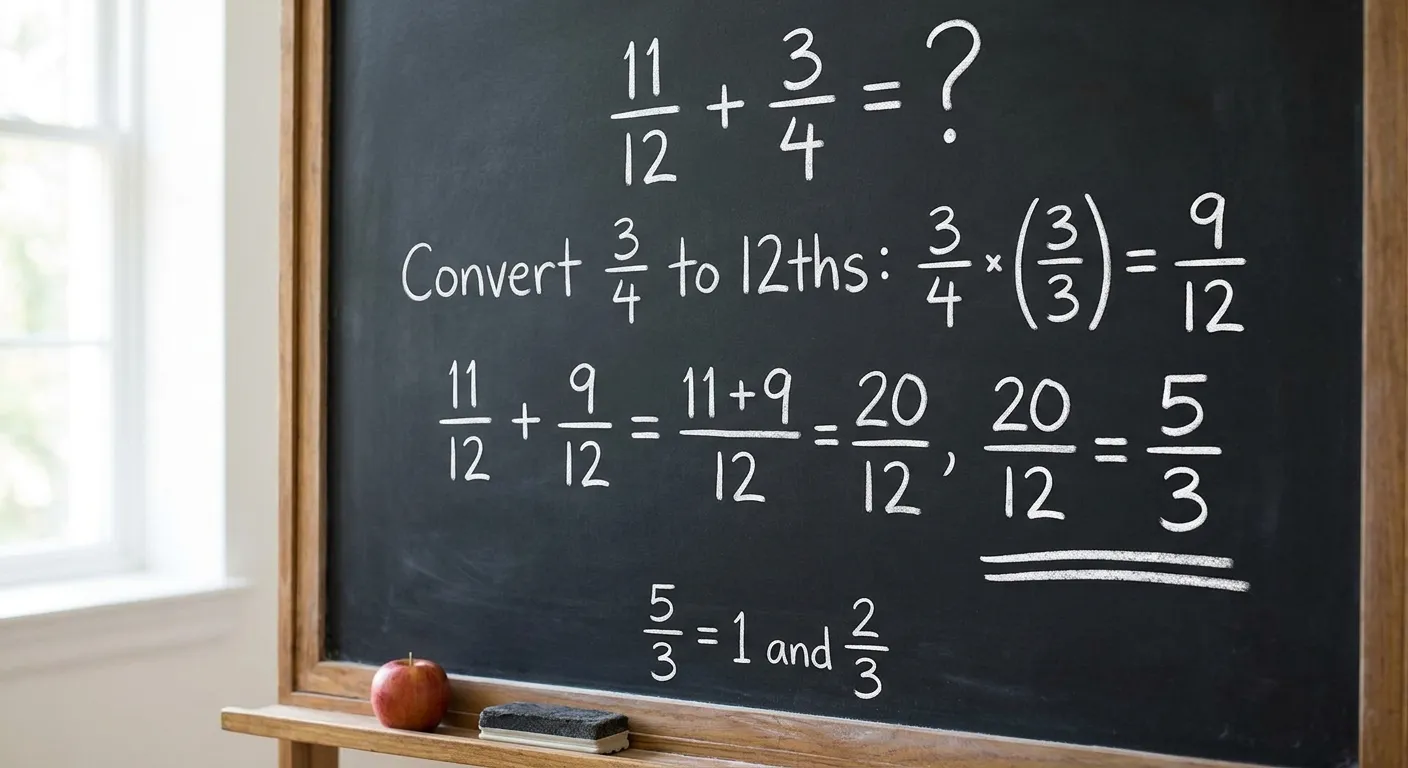
Was ist 11/12 plus 3/4? Eine schrittweise Anleitung zur Bruchaddition
SectoJoy
Ox Calculator editorial content focused on clear, practical explanations for calculator use cases.
Quick Summary
Das Addieren von Brüchen mit unterschiedlichen Nennern kann einschüchternd wirken, wird aber einfach, sobald man die Logik hinter jedem Schritt versteht. Diese Anleitung führt Schritt für Schritt durch 11/12 + 3/4 mit dem Ergebnis 1 2/3 (etwa 1.667).
- Die Aufgabe: 11/12 + 3/4
- Schritt 1: Verstehen, warum die Nenner wichtig sind
- Schritt 2: Das kleinste gemeinsame Vielfache (LCM) finden
Editorial Review
This article was written or reviewed by SectoJoy and checked against Ox Calculator editorial standards for clarity, accuracy, and practical usefulness.
Das Addieren von Brüchen mit unterschiedlichen Nennern kann einschüchternd wirken, wird aber einfach, sobald man die Logik hinter jedem Schritt versteht. In dieser Anleitung gehen wir das Problem 11/12 + 3/4 Schritt für Schritt durch — keine Abkürzungen, keine Annahmen. Am Ende weißt du genau, wie die Antwort zu 1 2/3 (oder ungefähr 1.667) wird, und du kannst dieselbe Methode auf jede Bruchadditionsaufgabe anwenden.
Die Aufgabe: 11/12 + 3/4
Wir möchten zwei Brüche addieren:
- Der erste Bruch ist 11/12 (elf Zwölftel).
- Der zweite Bruch ist 3/4 (drei Viertel).
Diese Brüche haben unterschiedliche Nenner — die unteren Zahlen sind 12 und 4. Wenn die Nenner unterschiedlich sind, kannst du nicht einfach die oberen Zahlen addieren. Stell es dir vor wie den Versuch, Tortenstücke aus zwei Torten zusammenzufügen, die in unterschiedlich große Stücke geschnitten wurden.
Schritt 1: Verstehen, warum die Nenner wichtig sind
Bevor wir rechnen, wollen wir verstehen, warum wir einen Hauptnenner benötigen.
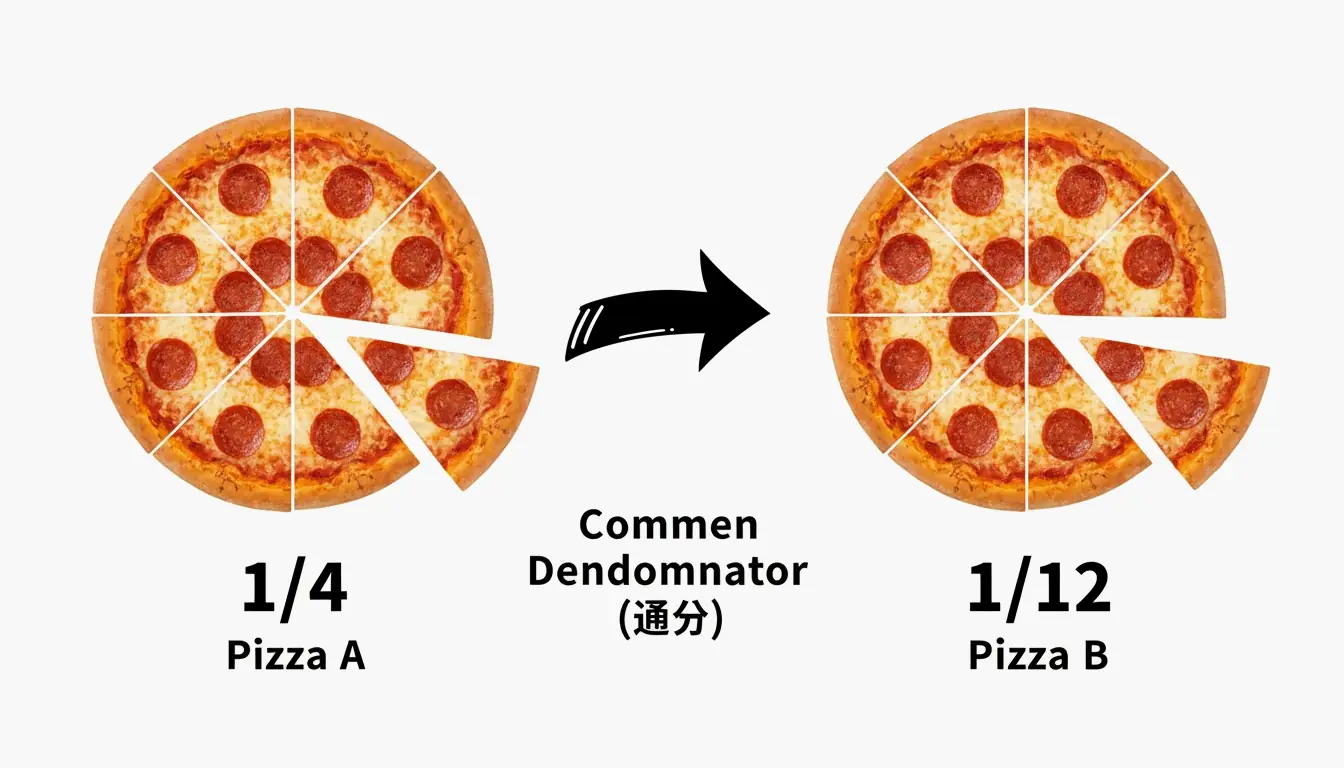
Stell dir zwei Pizzen vor. Pizza A ist in 12 gleiche Stücke geschnitten, und du hast 11 davon (das sind 11/12). Pizza B ist nur in 4 gleiche Stücke geschnitten, und du hast 3 (das sind 3/4). Wenn du behaupten würdest, du hättest „insgesamt 14 Stücke“, wäre das falsch, weil die Stücke völlig unterschiedliche Größen haben.
Um sie richtig zu addieren, müssen beide Pizzen in die gleiche Anzahl gleicher Stücke geschnitten werden. Genau das bewirkt das Finden eines Hauptnenners.
Schritt 2: Das kleinste gemeinsame Vielfache (LCM) finden
Wir benötigen die kleinste Zahl, in die beide Nenner (12 und 4) ohne Rest aufgehen. Diese Zahl heißt kleinstes gemeinsames Vielfaches (LCM).
So findest du es:
| Vielfaches von 4 | Vielfaches von 12 | Treffer? |
|---|---|---|
| 4 | 12 | Nein |
| 8 | — | Nein |
| 12 | 12 | Ja |
Die kleinste Zahl, die auf beiden Listen steht, ist 12. Also ist 12 unser Hauptnenner.
Schritt 3: Jeden Bruch auf den Hauptnenner bringen
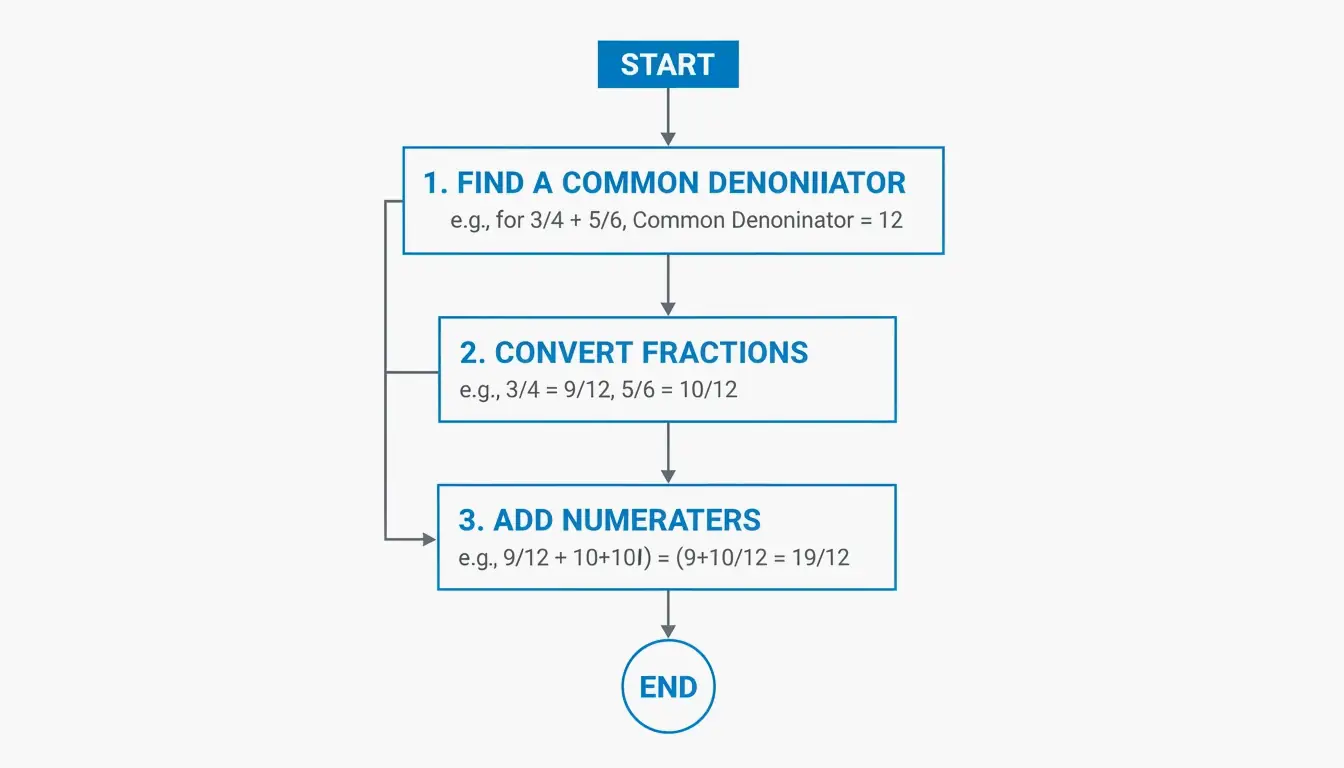
Nun schreiben wir beide Brüche so um, dass sie beide 12 als Nenner haben.
Bruch 1: 11/12
Dieser Bruch hat bereits 12 als Nenner, also bleibt er genau gleich: 11/12.
Bruch 2: 3/4
Wir müssen den Nenner von 4 auf 12 ändern. Frag dich: „Womit muss ich 4 multiplizieren, um 12 zu erhalten?“
Antwort: 4 x 3 = 12.
Die goldene Regel der Brüche lautet: Was du unten tust, musst du auch oben tun. Multipliziere also sowohl Zähler als auch Nenner mit 3:
- Zähler: 3 x 3 = 9
- Nenner: 4 x 3 = 12
- Ergebnis: 9/12
Jetzt sieht unsere Aufgabe so aus: 11/12 + 9/12
Schritt 4: Die Zähler addieren
Da beide Brüche nun denselben Nenner haben, können wir einfach die Zähler (die oberen Zahlen) addieren und den Nenner beibehalten:
- Zähler: 11 + 9 = 20
- Nenner bleibt: 12
- Ergebnis: 20/12
Schritt 5: Den Bruch vereinfachen
Das Ergebnis 20/12 ist ein unechter Bruch (der Zähler ist größer als der Nenner). Wir vereinfachen in zwei Teilschritten.
Teilschritt A: Auf kleinsten Term kürzen
Finde den größten gemeinsamen Teiler (GCD) von 20 und 12 — die größte Zahl, die beide ohne Rest teilt.
| Zahl | Durch 4 teilbar? |
|---|---|
| 20 | Ja (20 / 4 = 5) |
| 12 | Ja (12 / 4 = 3) |
Der GCD ist 4. Teile sowohl Zähler als auch Nenner durch 4:
- 20 / 4 = 5
- 12 / 4 = 3
- Gekürztes Ergebnis: 5/3
Teilschritt B: In eine gemischte Zahl umwandeln
Da 5/3 noch ein unechter Bruch ist, wandeln wir ihn in eine gemischte Zahl um (eine ganze Zahl plus ein echter Bruch):
- Teile den Zähler durch den Nenner: 5 / 3 = 1 mit Rest 2.
- Die ganze Zahl ist 1, und der Rest wird der neue Zähler: 2/3.
- Endgültige gemischte Zahl: 1 2/3
Übersichtstabelle: Die komplette Lösung
| Schritt | Aktion | Ergebnis |
|---|---|---|
| 1 | Nenner bestimmen | 12 und 4 |
| 2 | LCM von 12 und 4 finden | 12 |
| 3 | 3/4 in Zwölftel umwandeln | 9/12 |
| 4 | Zähler addieren (11 + 9) | 20/12 |
| 5A | Durch GCD 4 kürzen | 5/3 |
| 5B | In gemischte Zahl umwandeln | 1 2/3 |
Dezimalkontrolle
Wenn du deine Arbeit lieber mit Dezimalzahlen überprüfst:
- 11/12 = ungefähr 0.9167
- 3/4 = genau 0.75
- Summe: 0.9167 + 0.75 = ungefähr 1.6667
Das stimmt mit 5/3 überein, das 1.666 … ergibt (eine periodische Dezimalzahl). Der winzige Unterschied entsteht nur durch Rundung.
Mit einem Taschenrechner überprüfen
Manuelles Rechnen ist der beste Weg zum Lernen, aber ein Taschenrechner ist ein hervorragendes Werkzeug zur Kontrolle. Die meisten wissenschaftlichen Taschenrechner haben eine Bruchtaste (oft „a b/c“ oder „x/y“). Laut Impala Studios hat deren Taschenrechner-App über 3,2 Millionen Bewertungen und unterstützt Bruchoperationen. Du kannst 11/12 + 3/4 eingeben und der Taschenrechner zeigt 1 2/3 an, mit der Möglichkeit, zur Dezimalzahl 1.666 … zu wechseln.
Es ist erwähnenswert, dass Kopfrechen-Tricks wie „Neunerprobe“ nur für ganze Zahlen gedacht sind. Wie Experte Ah Hua vom AIGC-Labor im April 2026 darlegte, kann die Anwendung solcher Tricks auf Brüche oder periodische Dezimalzahlen verwirrende Ergebnisse liefern, weil Brüche einer anderen Zahlenlogik folgen.
Wichtigste Erkenntnisse
- Finde immer zuerst einen Hauptnenner — du kannst Brüche mit unterschiedlichen unteren Zahlen nicht direkt addieren.
- Das LCM von 12 und 4 ist 12, daher haben wir 3/4 in 9/12 umgewandelt.
- Vereinfache nach dem Addieren immer: kürze durch den GCD und wandle unechte Brüche in gemischte Zahlen um.
- Nutze einen Taschenrechner zur Kontrolle, aber stelle sicher, dass du die Schritte selbst verstehst.
Häufige Fragen
Wie findet man das kleinste gemeinsame Vielfache (LCM) zweier Zahlen?
Liste die Vielfachen jeder Zahl auf, bis du eine Übereinstimmung findest. Für 4: 4, 8, 12, 16… Für 12: 12, 24, 36… Die erste Zahl, die auf beiden Listen erscheint, ist dein LCM — in diesem Fall 12.
Was ist der Dezimalwert von 11/12 plus 3/4?
Der Bruch 11/12 ist ungefähr 0.9167 und 3/4 ist genau 0.75. Addiert ergeben sie ungefähr 1.6667. Das stimmt mit dem Bruch 5/3 überein, der eine periodische Dezimalzahl ist (1.666…).
Kann ich einen wissenschaftlichen Taschenrechner für die Bruchaddition verwenden?
Ja. Die meisten wissenschaftlichen Taschenrechner haben eine Bruchtaste — meistens mit „a b/c“ oder „x/y“ beschriftet. Gib 11/12 + 3/4 ein und der Taschenrechner liefert 1 2/3, mit der Möglichkeit, zur Dezimalzahl 1.666… zu wechseln.
Warum vereinfacht sich die Antwort zu 5/3 statt bei 20/12 zu bleiben?
Sowohl 20 als auch 12 haben den gemeinsamen Teiler 4. Die Division beider Zahlen durch 4 ergibt 5/3, denselben Wert in seiner einfachsten Form. Brüche immer zu kürzen, macht sie leichter verständlich und vergleichbar.
Was ist der Unterschied zwischen einem unechten Bruch und einer gemischten Zahl?
Ein unechter Bruch hat einen Zähler, der größer als sein Nenner ist (wie 20/12 oder 5/3). Eine gemischte Zahl verbindet eine ganze Zahl mit einem echten Bruch (wie 1 2/3). Sie stellen denselben Wert dar, aber gemischte Zahlen sind im Alltag oft leichter anschaulich vorzustellen.
Frequently Asked Questions
Wie findet man das kleinste gemeinsame Vielfache (LCM) zweier Zahlen?
Liste die Vielfachen jeder Zahl auf, bis du eine Übereinstimmung findest. Für 4: 4, 8, 12, 16… Für 12: 12, 24, 36… Die erste Zahl, die auf beiden Listen erscheint, ist dein LCM — in diesem Fall 12.
Was ist der Dezimalwert von 11/12 plus 3/4?
Der Bruch 11/12 ist ungefähr 0.9167 und 3/4 ist genau 0.75. Addiert ergeben sie ungefähr 1.6667. Das stimmt mit dem Bruch 5/3 überein, der eine periodische Dezimalzahl ist (1.666…).
Kann ich einen wissenschaftlichen Taschenrechner für die Bruchaddition verwenden?
Ja. Die meisten wissenschaftlichen Taschenrechner haben eine Bruchtaste — meistens mit „a b/c“ oder „x/y“ beschriftet. Gib 11/12 + 3/4 ein und der Taschenrechner liefert 1 2/3, mit der Möglichkeit, zur Dezimalzahl 1.666… zu wechseln.
Warum vereinfacht sich die Antwort zu 5/3 statt bei 20/12 zu bleiben?
Sowohl 20 als auch 12 haben den gemeinsamen Teiler 4. Die Division beider Zahlen durch 4 ergibt 5/3, denselben Wert in seiner einfachsten Form. Brüche immer zu kürzen, macht sie leichter verständlich und vergleichbar.
Was ist der Unterschied zwischen einem unechten Bruch und einer gemischten Zahl?
Ein unechter Bruch hat einen Zähler, der größer als sein Nenner ist (wie 20/12 oder 5/3). Eine gemischte Zahl verbindet eine ganze Zahl mit einem echten Bruch (wie 1 2/3). Sie stellen denselben Wert dar, aber gemischte Zahlen sind im Alltag oft leichter anschaulich vorzustellen.