What is 11/12 Plus 3/4? A Step-by-Step Fraction Addition Guide

What is 11/12 Plus 3/4? A Step-by-Step Fraction Addition Guide

SectoJoy
閱讀約 5 分鐘

SectoJoy

Ox Calculator editorial content focused on clear, practical explanations for calculator use cases.

在 X 上追蹤作者

Quick Summary

Adding fractions with different denominators can feel i

  • The Problem: 11/12 + 3/4
  • Step 1: Understand Why Denominators Matter
  • Step 2: Find the Least Common Multiple (LCM)

Editorial Review

This article was written or reviewed by SectoJoy and checked against Ox Calculator editorial standards for clarity, accuracy, and practical usefulness.

Adding fractions with different denominators can feel intimidating, but it becomes simple once you understand the logic behind each step. In this guide, we will walk through the problem 11/12 + 3/4 one step at a time — no shortcuts, no assumptions. By the end, you will know exactly how the answer becomes 1 2/3 (or approximately 1.667), and you will be able to apply the same method to any fraction addition problem.

The Problem: 11/12 + 3/4

We want to add two fractions:

  • The first fraction is 11/12 (eleven twelfths).
  • The second fraction is 3/4 (three quarters).

These fractions have different denominators — the bottom numbers are 12 and 4. When the denominators are different, you cannot simply add the top numbers together. Think of it like trying to combine slices from two pies that were cut into different-sized pieces.

Step 1: Understand Why Denominators Matter

Before we do any arithmetic, let us understand why we need a common denominator.

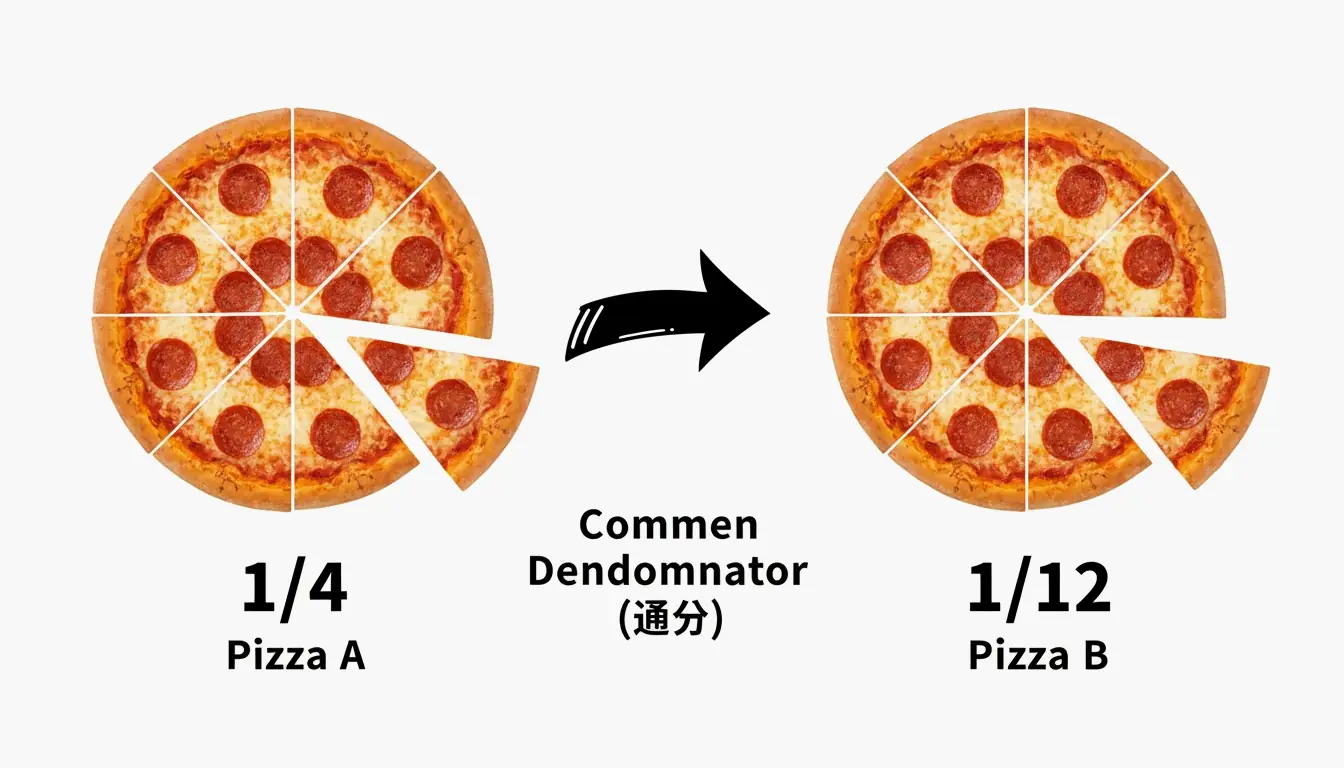
Imagine two pizzas. Pizza A is cut into 12 equal slices, and you have 11 of them (that is 11/12). Pizza B is cut into only 4 equal pieces, and you have 3 (that is 3/4). If you tried to say you have “14 pieces total,” that would be wrong because the pieces are completely different sizes.

To add them properly, both pizzas need to be cut into the same number of equal slices. That is exactly what finding a common denominator does.

Step 2: Find the Least Common Multiple (LCM)

We need the smallest number that both denominators (12 and 4) can divide into evenly. This number is called the Least Common Multiple (LCM).

Here is how to find it:

Multiple of 4 Multiple of 12 Match?
4 12 No
8 No
12 12 Yes

The smallest number on both lists is 12. So, 12 is our common denominator.

Step 3: Convert Each Fraction to the Common Denominator

Now we rewrite both fractions so they both have 12 as the denominator.

Fraction 1: 11/12
This fraction already has 12 as the denominator, so it stays exactly the same: 11/12.

Fraction 2: 3/4
We need to change the denominator from 4 to 12. Ask yourself: “What do I multiply 4 by to get 12?”
Answer: 4 x 3 = 12.

The golden rule of fractions is: whatever you do to the bottom, you must also do to the top. So multiply both the numerator and the denominator by 3:

  • Numerator: 3 x 3 = 9
  • Denominator: 4 x 3 = 12
  • Result: 9/12

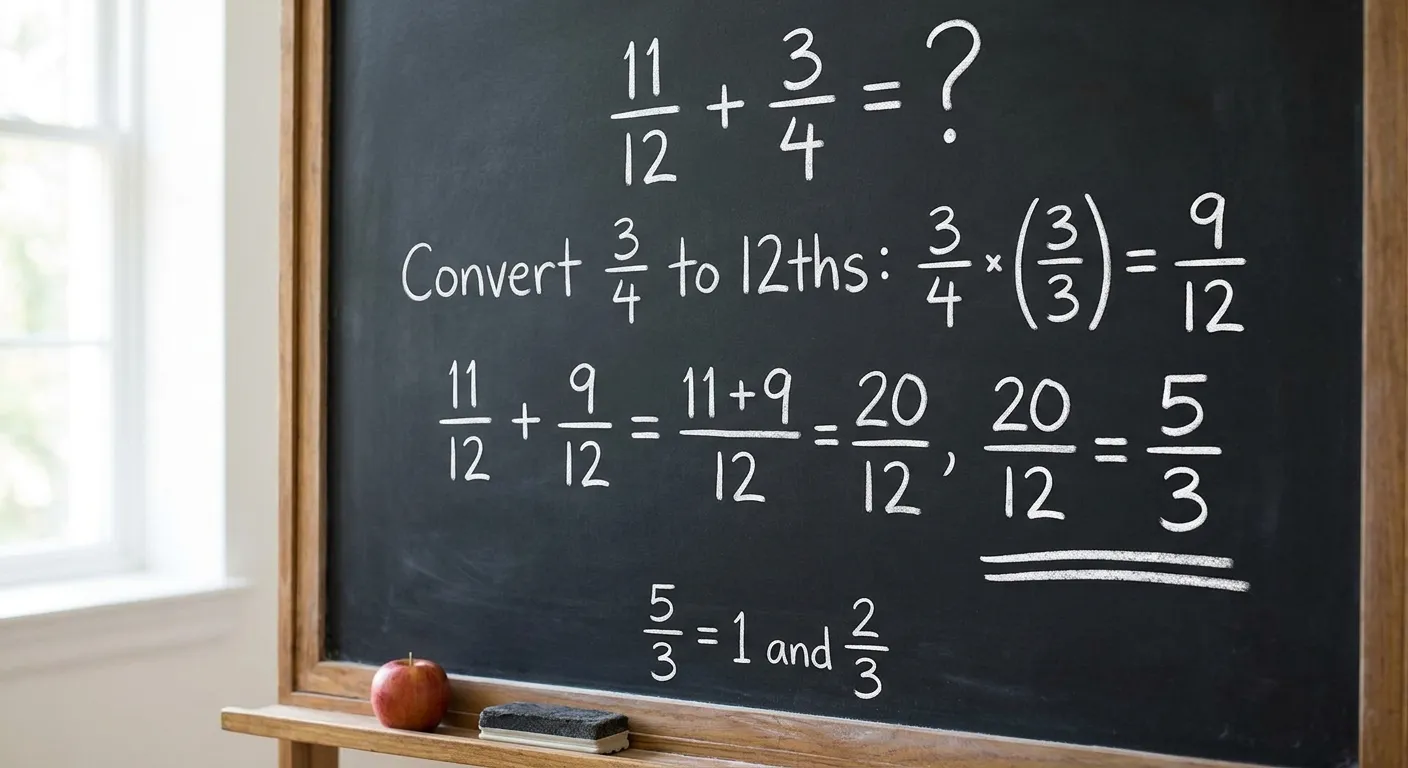
Now our problem looks like this: 11/12 + 9/12

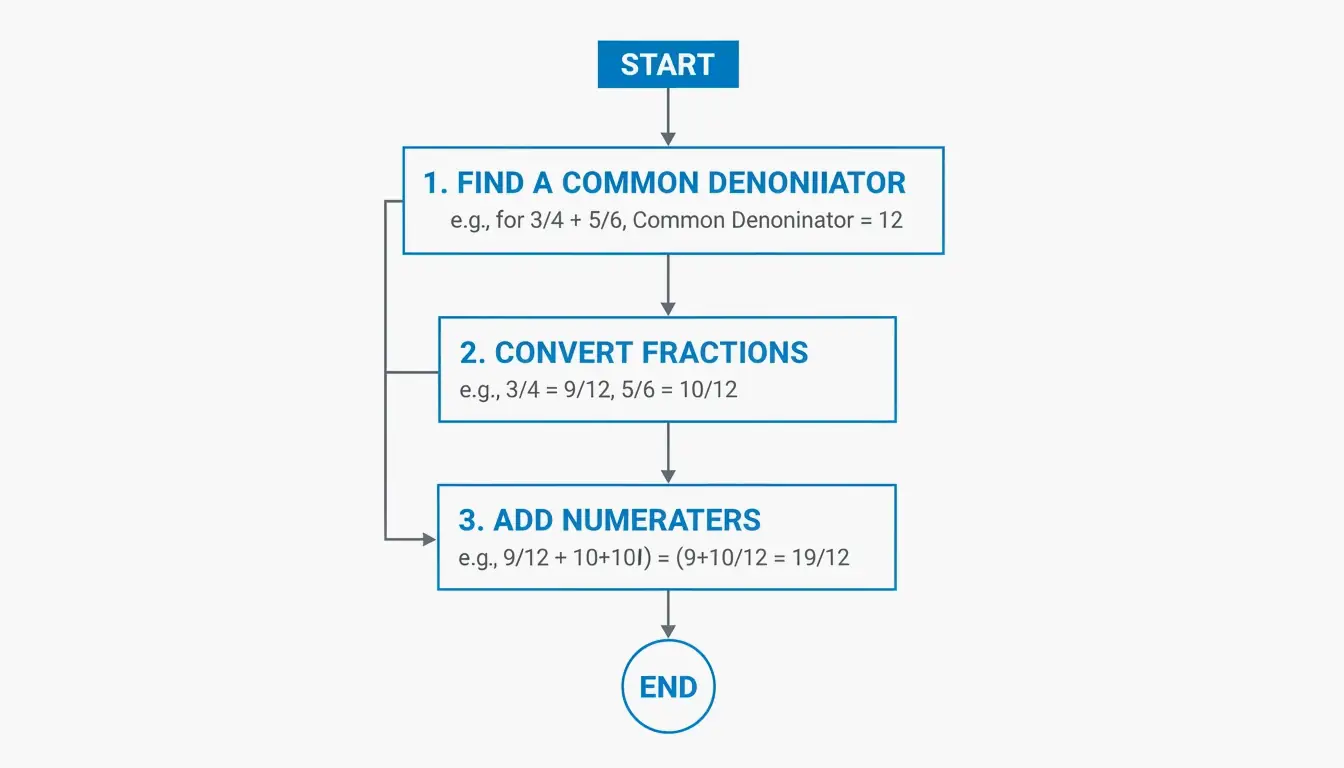
Step-by-step fraction addition flowchart: finding common denominators

Step 4: Add the Numerators

Since both fractions now share the same denominator, we can simply add the numerators (the top numbers) and keep the denominator the same:

  • Numerators: 11 + 9 = 20
  • Denominator stays: 12
  • Result: 20/12

Visual comparison of pie slices with different sizes

Step 5: Simplify the Fraction

The result 20/12 is an improper fraction (the numerator is larger than the denominator). We simplify in two sub-steps.

Sub-step A: Reduce to Lowest Terms

Find the Greatest Common Divisor (GCD) of 20 and 12 — the largest number that divides into both evenly.

Number Divisible by 4?
20 Yes (20 / 4 = 5)
12 Yes (12 / 4 = 3)

The GCD is 4. Divide both the numerator and denominator by 4:

  • 20 / 4 = 5
  • 12 / 4 = 3
  • Reduced result: 5/3

Sub-step B: Convert to a Mixed Number

Since 5/3 is still an improper fraction, let us convert it to a mixed number (a whole number plus a proper fraction):

  1. Divide the numerator by the denominator: 5 / 3 = 1 with a remainder of 2.
  2. The whole number is 1, and the remainder becomes the new numerator: 2/3.
  3. Final mixed number: 1 2/3

Summary Table: The Complete Solution

Step Action Result
1 Identify denominators 12 and 4
2 Find LCM of 12 and 4 12
3 Convert 3/4 to twelfths 9/12
4 Add numerators (11 + 9) 20/12
5A Reduce by GCD of 4 5/3
5B Convert to mixed number 1 2/3

Decimal Verification

If you prefer to check your work with decimals:

  • 11/12 = approximately 0.9167
  • 3/4 = exactly 0.75
  • Sum: 0.9167 + 0.75 = approximately 1.6667

This matches 5/3, which equals 1.666… (a repeating decimal). The slight difference is just rounding.

Using a Calculator to Double-Check

Manual calculation is the best way to learn, but a calculator is a great tool for verification. Most scientific calculators have a fraction button (often labeled “a b/c” or “x/y”). According to Impala Studios, their calculator app has over 3.2 million ratings and supports fraction operations. You can enter 11/12 + 3/4 and the calculator will display 1 2/3, with an option to toggle to the decimal 1.666….

It is worth noting that mental math shortcuts like “Casting Out Nines” are designed for whole numbers only. As Expert Ah Hua from the AIGC Laboratory pointed out in April 2026, applying such tricks to fractions or repeating decimals can produce confusing results because fractions follow a different numerical logic.

Key Takeaways

  1. Always find a common denominator first — you cannot add fractions with different bottom numbers directly.
  2. The LCM of 12 and 4 is 12, so we converted 3/4 into 9/12.
  3. After adding, always simplify: reduce by the GCD, then convert improper fractions to mixed numbers.
  4. Use a calculator to verify, but make sure you understand the steps yourself.

FAQ

How do you find the least common multiple (LCM) of two numbers?

List the multiples of each number until you find a match. For 4: 4, 8, 12, 16… For 12: 12, 24, 36… The first number that appears on both lists is your LCM — in this case, 12.

What is the decimal value of 11/12 plus 3/4?

The fraction 11/12 is approximately 0.9167, and 3/4 is exactly 0.75. Added together, they equal approximately 1.6667. This matches the fraction 5/3, which is a repeating decimal (1.666…).

Can I use a scientific calculator to solve fraction additions?

Yes. Most scientific calculators have a fraction button — usually labeled “a b/c” or “x/y.” Enter 11/12 + 3/4 and the calculator will give you 1 2/3, with an option to toggle to the decimal 1.666…

Why does the answer simplify to 5/3 instead of staying at 20/12?

Both 20 and 12 share a common factor of 4. Dividing both numbers by 4 gives 5/3, which is the same value written in its simplest form. Always reducing fractions makes them easier to understand and compare.

What is the difference between an improper fraction and a mixed number?

An improper fraction has a numerator that is larger than its denominator (like 20/12 or 5/3). A mixed number combines a whole number with a proper fraction (like 1 2/3). They represent the same value, but mixed numbers are often easier to visualize in everyday situations.

Frequently Asked Questions

How do you find the least common multiple (LCM) of two numbers?

List the multiples of each number until you find a match. For 4: 4, 8, 12, 16… For 12: 12, 24, 36… The first number that appears on both lists is your LCM — in this case, 12.

What is the decimal value of 11/12 plus 3/4?

The fraction 11/12 is approximately 0.9167, and 3/4 is exactly 0.75. Added together, they equal approximately 1.6667. This matches the fraction 5/3, which is a repeating decimal (1.666…).

Can I use a scientific calculator to solve fraction additions?

Yes. Most scientific calculators have a fraction button — usually labeled “a b/c” or “x/y.” Enter 11/12 + 3/4 and the calculator will give you 1 2/3, with an option to toggle to the decimal 1.666…

Why does the answer simplify to 5/3 instead of staying at 20/12?

Both 20 and 12 share a common factor of 4. Dividing both numbers by 4 gives 5/3, which is the same value written in its simplest form. Always reducing fractions makes them easier to understand and compare.

What is the difference between an improper fraction and a mixed number?

An improper fraction has a numerator that is larger than its denominator (like 20/12 or 5/3). A mixed number combines a whole number with a proper fraction (like 1 2/3). They represent the same value, but mixed numbers are often easier to visualize in everyday situations.

相關文章